
Facebook Monetization Requirements 2026: How to Check If a Page Is Monetized
Facebook Monetization Requirements 2026: How to Check If a Page Is Monetized
Can a Facebook Page actually make money in 2026?
Yes — but Facebook monetization has changed significantly, and many old articles still describe requirements and programs that are no longer the best way to understand the current system.
That's especially important if you're evaluating an established Facebook Page.
A seller might advertise:
"Facebook Page — Monetized"
But what exactly does that mean?
Before you value a Page based on monetization, you need to understand its current status, earnings history, content quality and eligibility.
Here's what Facebook Page owners and potential buyers should know in 2026.
What Is Facebook Content Monetization?
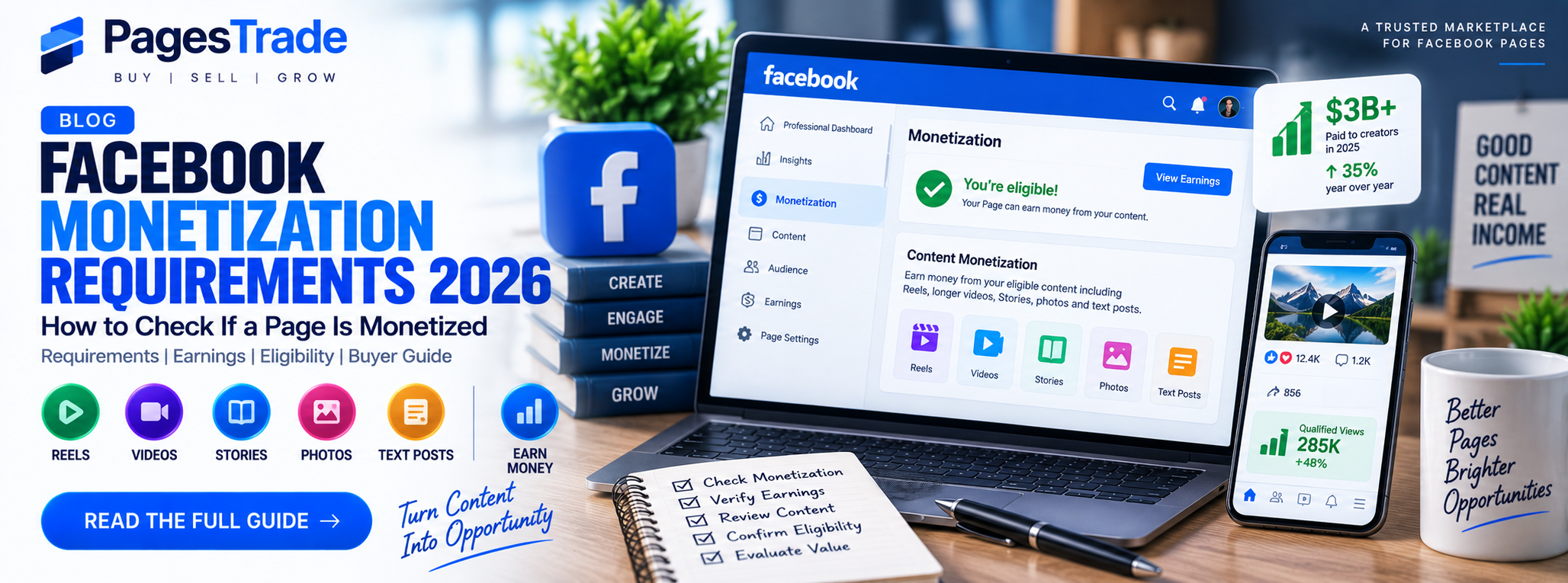
Facebook has consolidated several older creator monetization programs into Facebook Content Monetization.
The program was designed to bring monetization for different content formats into a more unified system.
Eligible creators can potentially earn from content including:
- Reels
- Longer-form videos
- Stories
- Photos
- Text posts
Instead of thinking only about old programs such as In-Stream Ads or Ads on Reels, creators should check their current Professional Dashboard to see what monetization products and opportunities are actually available to them.
Is Facebook Content Monetization Open to Everyone?
No.
As of 2026, Facebook Content Monetization is still an invite-only program.
However, eligible creators may be able to express interest from Facebook's Professional Dashboard.
The available options can vary by account, Page, country and program status.
That means you should be careful with websites promising:
"Get monetized automatically when you reach X followers."
There isn't one universal follower number that guarantees entry into the current Facebook Content Monetization program.
How to Check Your Facebook Monetization Status
The safest approach is to check directly inside Facebook rather than relying on a third-party eligibility calculator.
On Facebook mobile, go to your:
Professional Dashboard → Monetization
Look for Content Monetization and any other monetization products available to your account.
Depending on your status, you may see information about:
- Eligibility
- Invitations
- Monetization setup
- Earnings
- Content performance
- Policy issues
- Payout information
- Interest forms
Facebook's interface changes frequently, so menu names and locations can move.
Always rely on the current dashboard shown on the account.
Don't Rely on Old Facebook Monetization Requirements
This is extremely important in 2026.
You may still find articles claiming that every Facebook Page needs exactly:
- 10,000 followers
- 600,000 watch minutes
- Five active videos
Those numbers came from older Facebook In-Stream Ads requirements.
They should not automatically be presented as the universal requirements for today's Facebook Content Monetization program.
Meta has moved toward a consolidated, performance-based monetization system.
Always check current eligibility directly inside Facebook.
How Does Facebook Pay Creators in 2026?
Facebook Content Monetization is performance-based.
In simple terms:
More eligible, valuable content performance can create more earning opportunities.
But raw views alone don't tell the whole story.
Meta introduced additional monetization metrics in 2026 to help creators better understand which views contribute to earnings.
These include concepts such as:
Qualified Views
Views that may qualify toward monetization earnings.
Earnings Rate
An approximate measure of earnings per 1,000 qualified views.
Non-Qualified Views
Views that don't qualify for earnings, along with additional information explaining why.
For creators, these metrics provide more insight into what actually generates revenue.
For buyers evaluating a monetized Facebook Page, they can also provide useful context when reviewing performance.
How Much Is Facebook Paying Creators?
Facebook's creator economy is substantial.
Meta reported that Facebook paid creators nearly $3 billion during 2025, representing approximately 35% growth from the previous year.
Meta also reported that around 60% of its creator payouts in 2025 came from Reels, while the remainder came from other eligible formats including Stories, photos and text posts.
That demonstrates an important shift:
Facebook monetization is no longer simply about long videos.
Creators can potentially build monetization strategies around several different content formats.
Original Content Matters More in 2026
One of the biggest changes creators need to understand is Meta's increased emphasis on original content.
Facebook has been taking stronger action against accounts that repeatedly reuse or copy other creators' work without adding meaningful value.
Original creators may receive stronger distribution and monetization opportunities, while unoriginal content can be deprioritized.
This matters enormously when evaluating an established Page.
Imagine you're considering two monetized Pages.
Page A
Publishes original videos, photography and commentary.
Page B
Mostly downloads viral videos from other accounts and reposts them.
Even if Page B currently has strong reach, its content model may carry significantly more long-term risk.
Don't evaluate current earnings without understanding how those earnings are being generated.
Spam Can Hurt Monetization
Facebook has also increased enforcement against spammy behavior.
Examples can include:
- Irrelevant captions
- Excessive distracting hashtags
- Coordinated spam networks
- Attempts to manipulate distribution
- Repetitive low-quality content
Meta has said that some accounts using spammy tactics can experience reduced reach and lose monetization eligibility.
So if you're evaluating a Page, don't look only at today's earnings.
Ask:
Is the strategy generating those earnings sustainable?
What Does "Monetized Facebook Page" Actually Mean?
This phrase can be misleading.
When someone advertises a Page as monetized, you should determine exactly what they're claiming.
Ask:
- Which monetization program is active?
- Is Content Monetization currently available?
- Is the Page earning now?
- How much has it earned recently?
- Which content generates the revenue?
- Are there policy warnings or restrictions?
- Is payout setup complete?
- Is the content original?
- Is revenue stable?
- Can these claims be independently verified?
Don't assume "monetized" automatically means "profitable."
A Page can technically have access to monetization while generating very little revenue.
How to Verify a Monetized Facebook Page Before Buying
If you're evaluating an established Page advertised as monetized, verification is essential.
Step 1: Check the Current Monetization Dashboard
Ask to see the current monetization status inside Facebook.
Old screenshots aren't enough.
Step 2: Review Recent Earnings
If revenue is part of the valuation, examine an appropriate recent period.
One successful day doesn't demonstrate stable income.
Step 3: Review the Content Producing Revenue
Determine whether earnings come from:
- Reels
- Videos
- Stories
- Photos
- Text posts
- Multiple formats
This helps you understand how dependent the Page is on one content type.
Step 4: Check for Restrictions
Look for current policy or monetization warnings.
Step 5: Review Content Ownership
Determine whether high-performing content is original, licensed or heavily dependent on reused material.
Step 6: Check Audience Quality
Monetization shouldn't replace normal Page due diligence.
Still review:
- Followers
- Engagement
- Reach
- Audience location
- Growth
- Page history
Monetized Doesn't Always Mean Valuable
Consider two hypothetical Pages.
Page A
Followers: 300,000
Monetized: Yes
Monthly earnings: $50
Reach: Declining
Content: Mostly reused
Page B
Followers: 80,000
Monetized: Yes
Monthly earnings: $700
Reach: Healthy
Content: Original
Audience: Highly engaged
Which Page looks stronger?
Follower count alone might make Page A appear more valuable.
But Page B may have a much stronger business case.
That's why buyers should evaluate actual monetization performance, not simply the presence of monetization access.
Revenue History Matters
Suppose a seller says:
"This Page makes $1,500 per month."
Ask for enough history to understand what that statement means.
For example:
| Month | Revenue |
|---|---|
| January | $1,420 |
| February | $1,510 |
| March | $1,475 |
| April | $1,530 |
| May | $1,490 |
That tells a very different story from:
| Month | Revenue |
|---|---|
| January | $120 |
| February | $90 |
| March | $4,500 |
| April | $80 |
| May | $100 |
Both Pages could technically be described using an impressive revenue claim if someone selectively chooses the best period.
Consistency matters.
Monetization Can Affect Facebook Page Value
A Page already generating verified, sustainable profit may be evaluated differently from a Page that has followers but no income.
Suppose a Page earns:
$500 per month in sustainable profit
That equals:
$6,000 per year
At this stage, buyers may begin thinking about the Page as an income-producing digital asset rather than simply an audience.
However, never apply a revenue multiple blindly.
Consider:
- Revenue stability
- Growth
- Content costs
- Operational workload
- Platform dependence
- Policy risk
- Content ownership
- Audience health
Verified revenue can increase value.
Unverified revenue claims shouldn't.
Facebook Monetization Buyer Checklist
Before paying a premium for a monetized Page, verify:
- Current monetization status
- Content Monetization access where claimed
- Recent earnings
- Earnings history
- Qualified content performance
- Current restrictions
- Content originality
- Audience quality
- Recent reach
- Engagement
- Audience countries
- Page history
- Revenue sustainability
If several of these cannot be verified, don't price the Page as if its revenue were guaranteed.
Can Monetization Be Guaranteed Forever?
No.
This is one of the most important things buyers need to understand.
Facebook controls its platform, monetization products, eligibility systems and policies.
Programs can change.
Eligibility can change.
Content performance can change.
Policy enforcement can change.
A Page being monetized today does not guarantee identical monetization or earnings forever.
That's why valuation should include platform risk.
Should You Buy a Facebook Page Just Because It's Monetized?
Not necessarily.
Monetization should be one part of your evaluation.
A stronger Page generally combines:
Real Audience + Engagement + Reach + Original Content + Clean History + Sustainable Monetization
If the audience is weak or the content model is risky, monetization access alone may not make it a good opportunity.
The Bottom Line
Facebook monetization in 2026 is very different from the simple follower-and-watch-time formulas found in many older guides.
Facebook Content Monetization brings multiple eligible content formats into a more unified, performance-based program, while Meta is placing greater emphasis on original content, qualified views and meaningful engagement.
For Page owners, the best place to check current eligibility is Facebook's Professional Dashboard.
For buyers, never pay a monetization premium based solely on a listing description.
Verify the status.
Verify the earnings.
Verify the content.
And evaluate whether the revenue looks sustainable.
Explore Facebook Pages on PagesTrade
PagesTrade helps users discover established Facebook Pages across different niches, audience sizes, price ranges and monetization statuses.
When comparing Pages, look beyond follower count.
Evaluate:
Audience + Engagement + Reach + Content + History + Monetization + Revenue
Browse Facebook Page listings on PagesTrade to discover opportunities that match your goals.
Own an established Facebook Page?
List your Page on PagesTrade and provide potential buyers with clear information about its audience, performance and monetization status.
This article is for general informational purposes. Meta's monetization programs, eligibility requirements, features and policies can change. Always verify current information directly through Meta before making business or purchasing decisions.