
How to Tell If a Facebook Page Has Fake Followers: 12 Warning Signs
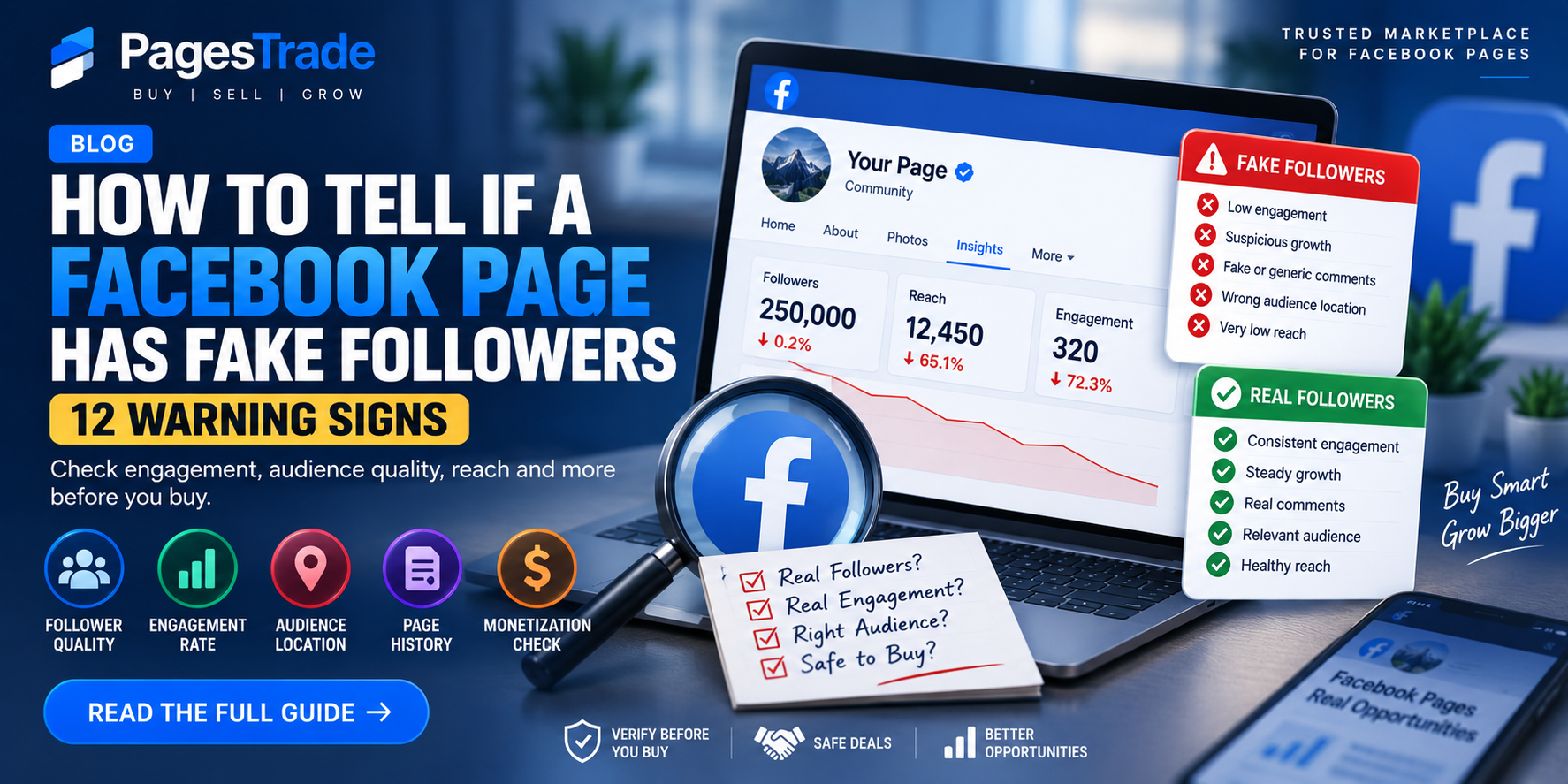
How to Tell If a Facebook Page Has Fake Followers: 12 Warning Signs
A Facebook Page has 300,000 followers.
Sounds valuable, right?
Not necessarily.
Follower count is one of the easiest numbers to notice, but it doesn't tell you whether those followers are real, active or relevant.
A smaller Page with a genuine and engaged audience can be far more useful than a huge Page filled with inactive, irrelevant or artificially acquired followers.
If you're evaluating an established Facebook Page, audience quality should be one of your first checks.
Here are 12 warning signs to investigate.
1. Huge Follower Count, Very Little Engagement
Start with the simplest comparison:
Followers vs. actual activity.
Imagine a Page has 250,000 followers, but its recent posts regularly receive:
- 20 reactions
- 1 or 2 comments
- Almost no shares
That doesn't automatically prove the followers are fake.
There can be other explanations, including an inactive audience, poor content, a major niche change or declining distribution.
But the mismatch is a reason to investigate further.
Don't ask only:
"How many followers does this Page have?"
Ask:
"How many of those followers are still paying attention?"
2. Sudden Unexplained Follower Spikes
Natural audience growth usually has a reason.
A viral video can generate thousands of new followers.
A successful advertising campaign can also cause rapid growth.
But if the Page suddenly jumps from 30,000 to 150,000 followers and the owner can't explain what caused it, look deeper.
Ask for historical follower-growth data.
You want to understand:
- When the growth happened
- What content caused it
- Whether advertising was involved
- Which countries the new followers came from
A sudden increase isn't automatically suspicious.
An unexplained increase is.
3. Engagement Doesn't Grow With the Audience
Suppose a Page had 20,000 followers and normally received 500 reactions per post.
It later grows to 200,000 followers — but still receives approximately the same engagement.
That's worth investigating.
If follower growth is genuine and relevant, you would generally hope to see some corresponding improvement in audience activity over time.
Look at historical posts before and after major growth periods.
4. Comments Look Generic or Repetitive
Comments can reveal a lot about audience quality.
Real communities tend to produce conversations related to the actual post.
Be cautious when large numbers of comments repeatedly look like:
- "Nice"
- "Great"
- "Wow"
- Random emojis
- Completely unrelated phrases
- Repeated identical comments
Again, don't make a decision from a few strange comments.
Look for patterns across many posts.
5. Audience Countries Don't Match the Content
Audience geography is extremely important.
Imagine you're evaluating a Page about local American businesses.
Its content is written for U.S. users, its branding targets Americans, and the seller describes it as a U.S. audience.
But the Page's insights show that only a small percentage of followers are actually in the United States.
That changes the picture considerably.
Ask for current audience data showing top countries and cities.
The important question isn't whether one country is "better" than another.
It's whether the actual audience matches the audience being advertised to you.
6. Lots of Followers but Extremely Low Reach
Followers and reach are not the same thing.
A Page may display 500,000 followers while its content reaches only a small portion of that audience.
Low reach doesn't automatically mean fake followers.
It can also result from:
- Long inactivity
- Poor content
- Changed audience interests
- A major niche switch
- Weak recent performance
But it tells you something important:
The headline follower count may not represent the Page's current ability to reach people.
That's why recent reach should be part of any serious Facebook Page evaluation.
7. The Page Changed Niches
This can create what looks like a fake-audience problem even when the followers themselves are real.
For example:
2022: Football
2023: Football
2024: Football
2025: Celebrity entertainment
2026: Business and investing
The Page might still have 400,000 genuine followers.
But many of those people followed for football — not investing.
The result can be a huge audience with very weak current engagement.
When evaluating a Page, scroll through its older content and understand what originally attracted the audience.
8. The Seller Shows Followers but Won't Show Insights
This is one of the biggest due-diligence warning signs.
If someone wants you to value a Page based on 300,000 followers but refuses to show recent performance information, you don't have enough information.
Ask for relevant current insights such as:
- Reach
- Engagement
- Follower growth
- Audience countries
- Audience demographics
- Recent content performance
Don't rely exclusively on the public follower number.
9. Only the Best Posts Are Shown
A seller might show you screenshots of three posts that received enormous reach.
That's useful information — but it isn't enough.
Those could be the Page's three best posts from the entire year.
Instead, examine normal performance.
Review the most recent 20–30 posts and, where possible, recent dashboard data.
You're trying to answer:
What does an average post do?
Consistency is often more useful for evaluation than one viral result.
10. The Audience Doesn't Interact Like a Community
A healthy Page often shows signs that real people care about the subject.
You may see:
- Relevant questions
- Discussions
- People tagging friends
- Shares
- Returning commenters
- Reactions appropriate to the content
An unhealthy audience can feel completely disconnected from what's being published.
Don't measure this from one post.
Review multiple pieces of content.
11. The Seller Can't Explain How the Page Grew
Ask a simple question:
"How did you build this audience?"
A legitimate owner may explain that the Page grew through:
- Original videos
- Reels
- Viral posts
- Organic content
- Advertising
- An established brand
- Community building
The explanation should reasonably match the Page's history.
If nobody can explain where hundreds of thousands of followers came from, investigate before assigning value to them.
12. The Price Is Based Entirely on Followers
Be careful with offers like:
"500K followers = $10,000."
That's not how serious Page evaluation should work.
Follower count is only one factor.
Consider:
| Metric | Why It Matters |
|---|---|
| Followers | Overall audience size |
| Reach | How many people currently see content |
| Engagement | Whether people interact |
| Audience location | Whether followers match your target |
| Growth history | How the audience was acquired |
| Niche | Commercial relevance |
| Page history | Past content and changes |
| Monetization | Current earning potential |
| Revenue | Proven financial performance |
| Policy status | Potential platform risk |
Two Facebook Pages with identical follower counts can have dramatically different values.
Are Low-Engagement Followers Always Fake?
No.
This distinction is important.
Low engagement does not automatically prove that followers were purchased or fabricated.
A Page can have genuine followers who became inactive because:
- The Page stopped posting
- Content quality declined
- The niche changed
- Followers lost interest
- The audience was built years ago
- Recent content no longer matches audience expectations
That's why you should avoid making a fake-follower judgment from one metric.
Look at several signals together.
How to Check a Facebook Page's Audience Before Buying
If you're evaluating an established Page, use a simple process.
Step 1: Review the public Page
Check recent posts, comments, reactions, content consistency and historical activity.
Step 2: Request recent insights
Look at reach, engagement, audience geography and follower growth.
Step 3: Compare followers with performance
Does the Page's current activity make sense relative to its audience size?
Step 4: Review historical content
Determine whether the niche changed and what originally built the audience.
Step 5: Verify important seller claims
If the seller claims a particular audience location, reach level, monetization status or revenue, ask for appropriate evidence.
Step 6: Look at the complete picture
Never classify an audience as genuine or low quality based on one number alone.
Example: Which Facebook Page Would You Choose?
Consider two Pages.
Page A
- 300,000 followers
- Very low recent engagement
- Weak reach
- Unclear audience growth
- Audience location doesn't match the niche
- Seller won't provide detailed insights
Page B
- 75,000 followers
- Consistent engagement
- Healthy recent reach
- Relevant audience geography
- Clear content history
- Seller provides recent insights
Which is more attractive?
Many buyers initially choose Page A because 300,000 looks bigger than 75,000.
But once audience quality is considered, Page B may represent the stronger opportunity.
That's exactly why follower count should never be evaluated alone.
Facebook Page Audience Quality Checklist
Before considering a Page, check:
- Follower count
- Recent reach
- Average engagement
- Comments
- Shares
- Audience countries
- Audience demographics
- Follower growth history
- Historical content
- Niche consistency
- Recent insights
- Seller claims
The more of these factors you can verify, the better you can understand what the audience is actually worth.
What Makes Facebook Followers Valuable?
The best audience isn't simply the biggest.
Valuable followers are generally:
Real + Relevant + Active + Reachable
If you're evaluating a Page for a particular business or content strategy, relevance matters too.
100,000 genuine followers interested in cooking may be excellent for a food brand but much less useful for a technology business.
Audience quality must always be evaluated in context.
Don't Pay for a Number — Evaluate the Page
A Facebook Page is more than the follower count displayed beneath its name.
Its real value comes from the quality of its audience, current performance, niche, history, reach and — where applicable — monetization and revenue.
Before considering any established Page, verify as much as possible.
If something doesn't make sense, investigate it.
If important information can't be verified, don't let a large follower number rush your decision.
Explore Established Facebook Pages on PagesTrade
PagesTrade helps buyers discover established Facebook Pages across different niches, audience sizes and price ranges.
When comparing opportunities, look beyond followers and evaluate the metrics that actually matter.
Browse Facebook Pages on PagesTrade and compare opportunities based on audience quality, engagement, niche and performance.
Already own an established Page?
List your Facebook Page on PagesTrade and provide buyers with the information they need to evaluate your audience.
This article is for general informational purposes. Meta's products, metrics, policies and interfaces can change over time. Buyers should independently verify important information and review applicable Meta policies before making decisions involving Facebook Pages.